Wednesday, July 15, 2026

From Claims Processing to Claims Intelligence!

As a technology leader, there are few moments more rewarding than seeing an idea evolve from a whiteboard discussion into a production platform that creates lasting business value. This was one of those moments.

Today, I want to share a success story that is especially meaningful to me.

Over the years, I've had the opportunity to lead many large-scale transformation initiatives, but this one stands out because I was involved in every stage of the journey—from concept and vision, to architecture and design, through implementation and production deployment.

The challenge was one that many insurance organizations face: vast amounts of unstructured information spread across policy documents, claims records, underwriting files, correspondence, and regulatory content. Critical business knowledge existed, but accessing it efficiently was often time-consuming, manual, and dependent on institutional knowledge.

Our vision was simple: transform information into intelligence.

By combining AI, Document Intelligence, and Knowledge Mining, we built a production-ready solution that could automatically ingest, classify, extract, enrich, and surface insights from millions of documents. The platform leveraged intelligent document processing to extract key business data, knowledge mining capabilities to connect related information across repositories, and AI-powered search and insights to enable employees to find what they needed in seconds rather than hours.

A critical element of the solution was our Document Intelligence accelerator, which automated data extraction from complex insurance documents, and a Knowledge Mining Portal that created a searchable, contextual knowledge layer across the enterprise. Equally important was keeping humans in the loop, ensuring validation, governance, and continuous improvement while maintaining the high levels of accuracy required in insurance operations.

The business impact was significant:

  • Reduced manual document review and processing effort
  • Improved operational efficiency and employee productivity
  • Faster access to business-critical knowledge
  • Enhanced underwriting and claims decision-making
  • Increased accuracy through a combination of AI automation and human oversight
  • Created a scalable foundation for future AI-driven innovation

What makes me most proud is that this wasn't just a proof of concept or pilot. It became a production-ready enterprise solution delivering measurable business value while helping teams focus on higher-value work rather than manual information gathering.

This experience reinforced something I strongly believe successful AI transformations are not just about deploying technology. They are about combining data, knowledge, governance, business expertise, and human judgment to create solutions that solve real business problems at scale.

As the insurance industry continues its AI journey, organizations that can unlock the value trapped within their documents and institutional knowledge will be better positioned to drive efficiency, improve customer outcomes, and accelerate innovation.

I'm proud to have led this initiative from inception to implementation, and even prouder of the business outcomes it continues to deliver today.

┌─────────────────────────────┐
│ Claim Submission Sources │
├─────────────────────────────┤
│ • FNOL Forms │
│ • Medical Reports │
│ • Adjuster Notes │
│ • Images & Photos │
│ • Emails & Attachments │
│ • Policy Documents │
└──────────────┬──────────────┘
│
▼
┌─────────────────────────────┐
│ Document Intelligence │
├─────────────────────────────┤
│ • OCR & Text Extraction │
│ • Classification │
│ • Entity Recognition │
│ • Metadata Extraction │
│ • Confidence Scoring │
└──────────────┬──────────────┘
│
▼
┌────────────────────────────┐
│ Human-in-the-Loop Review │
├────────────────────────────┤
│ Validate Low Confidence │
│ Correct Exceptions │
│ Improve Training Data │
│ Compliance Verification │
└──────────────┬─────────────┘
│
▼
┌─────────────────────────────┐
│ Knowledge Mining Portal │
├─────────────────────────────┤
│ • Document Indexing │
│ • Semantic Search │
│ • Knowledge Graph │
│ • Data Enrichment │
│ • Cross-System Correlation │
└──────────────┬──────────────┘
│
▼
┌─────────────────────────────┐
│ Enterprise Data Platform │
├─────────────────────────────┤
│ Claims Data │
│ Policy Data │
│ Customer Data │
│ Historical Loss Data │
│ External Data Sources │
└──────────────┬──────────────┘
│
▼
┌─────────────────────────────┐
│ AI Decision Intelligence │
├─────────────────────────────┤
│ • Fraud Detection │
│ • Risk Scoring │
│ • Document Completeness │
│ • Next Best Action │
│ • Recommendation Engine │
└──────────────┬──────────────┘
│
▼
┌─────────────────────────────┐
│ Claims Adjuster Workspace │
├─────────────────────────────┤
│ Contextual Recommendations │
│ Unified Customer View │
│ Automated Summaries │
│ Guided Workflows │
└──────────────┬──────────────┘
│
▼
┌─────────────────────────────┐
│ Business Outcomes │
├─────────────────────────────┤
│ Faster Claim Resolution │
│ Improved Accuracy │
│ Reduced Leakage │
│ Better Customer Experience │
│ Continuous Model Learning │

└─────────────────────────────┘

Equally important was the implementation of a robust Human-in-the-Loop (HITL) process. AI-powered extraction and classification were supported by confidence scoring mechanisms that automatically flagged exceptions, ambiguous results, or high-risk decisions for human review. Claims experts validated critical information, corrected inaccuracies, and provided continuous feedback to improve model performance over time. This combination of AI automation and human expertise created a trusted decision-support environment that increased accuracy while ensuring regulatory compliance and business accountability. Rather than replacing human judgment, the solution amplified it by allowing skilled professionals to focus on the most critical decisions.


Monday, July 13, 2026

The Real Edge in Capital Markets AI: Industry Context, Not Algorithms

 There is a temptation in AI conversations to focus on the model — which model, how big, how fast, how accurate. But in capital markets, I’ve consistently seen that the differentiator isn’t the algorithm.

It’s the context.

In one anonymized case, a client wanted to apply generative AI to automate client reporting across portfolios. The initial ask was straightforward: “Can AI generate reports faster?” The deeper question we explored was far more valuable: What should the report actually say — and why? That led us into understanding client personas, regulatory expectations, and the nuances of portfolio performance narratives.

We designed an AI-driven reporting capability that didn’t just generate text — it generated context-aware insights. For example:

  • Explaining performance attribution in line with investment strategy
  • Highlighting risk exposure changes in a way clients actually understand
  • Tailoring tone and depth based on institutional vs retail audiences

This was not an AI problem. It was a domain intelligence problem enabled by AI.

As consultants, especially in capital markets, our credibility comes from this layer. AI amplifies expertise — but it cannot replace it. The more we invest in understanding the business, the sharper our AI solutions become.

There’s a moment I often see in AI conversations: A client leans forward and asks: “Which model should we use?”

It’s a fair question — but rarely the right starting point.

Because in capital markets, the real differentiator isn’t the model. It’s the context around the decision the model is supporting. And that’s where I’ve seen the biggest gap — and the biggest opportunity.


Where the Conversation Usually Starts… and Where It Should Go

In one anonymized engagement, a client wanted to use generative AI to automate portfolio reporting. The initial ask was simple: “Can we generate reports faster?”

Technically — yes. That’s the easy part.

But when we stepped back, I asked a different set of questions:

  • Who is the end reader, and what do they actually care about?
  • What decisions does this report influence?
  • Where do clients typically question or challenge the content?
  • How do regulators expect these narratives to be structured?

That shifted the conversation completely.

We moved from “automating report writing” to redefining how insights are generated and communicated.


What We Built — And Why It Mattered

Instead of a generic text-generation solution, we designed a context-aware reporting capability:

  • AI-generated narratives aligned to investment strategy and benchmarks
  • Dynamic commentary on performance attribution and risk exposures
  • Tone and depth adjusted for institutional vs retail clients
  • Embedded controls to ensure consistency with compliance language

What made the difference wasn’t the AI itself — it was the layer of financial intelligence and business context wrapped around it.

And this is something I’ve seen consistently:

AI without context produces output.
AI with context produces insight.


My POV: Domain Intelligence Is the New Competitive Moat

As AI becomes more accessible, the barrier to entry for building models is lowering quickly.

So where does differentiation come from?

Not from the model.
From how well you understand:

  • The business problem
  • The decision-making process
  • The regulatory environment
  • The client expectations
  • The data ecosystem

In capital markets, this matters even more because decisions are nuanced, high-stakes, and often subjective.

I often remind my teams:

“If we don’t understand how a portfolio manager or risk officer thinks, we’re not building a solution — we’re building a tool that will be ignored.”


Practical Recommendations I Bring Into Every Engagement

Over time, I’ve shaped a few principles that I consistently apply to make AI solutions truly impactful.


1. Anchor Everything in Decision Context

Before writing a single line of code, define:

  • What decision is this supporting?
  • What inputs matter most?
  • What level of precision vs explainability is required?

This prevents solutions from becoming disconnected from real business value.


2. Design for Personas — Not Just Use Cases

A single use case often has multiple stakeholders.

In portfolio reporting, for example:

  • Portfolio managers focus on attribution and strategy
  • Relationship managers care about clarity and storytelling
  • Compliance cares about consistency and defensibility

AI solutions need to adapt to these personas — not treat them as one.


3. Embed Industry Language Into the System

Generic AI outputs are one of the fastest ways to lose credibility.

We intentionally design systems that understand:

  • Financial terminology
  • Market conventions
  • Regulatory phrasing
  • Organizational tone

This turns AI from “assistive” to aligned with how the business speaks and operates.


4. Don’t Just Automate — Enhance Insight

A common trap is focusing on efficiency alone.

Instead of asking: “Can we do this faster?”

Ask: “Can we do this better, more consistently, and more insightfully?”

In many cases, AI can surface patterns or narratives that weren’t visible before — and that’s where real value lies.


5. Build Feedback Loops From Day One

AI systems improve when users interact with them.

We design for:

  • User corrections feeding back into the system
  • Continuous tuning based on real-world usage
  • Audit trails capturing how outputs evolve

This ensures the solution doesn’t remain static.


A Consulting Mindset That Makes This Work

This is where I believe our role, as consultants, becomes critical.

Move Beyond “Answering the Ask”

Clients often articulate a problem in operational terms.
Our role is to translate that into strategic opportunity.


Bring Industry Perspective — Even When It Challenges the Client

Some of the most valuable conversations I’ve had start with:

“Here’s what we’re seeing across the industry…”

This helps clients step outside their internal lens and consider what’s possible.


Balance Respect With Challenge

It’s important to honor where the client is — their constraints, their priorities, their pace.

But it’s equally important to push the conversation forward.

Not aggressively — but thoughtfully.


Think in Systems, Not Features

The best AI solutions are not isolated capabilities.

They are:

  • Integrated with data ecosystems
  • Embedded in workflows
  • Governed responsibly
  • Designed to scale

That requires architectural thinking from day one.


What I’ve Learned Personally

If I reflect on my own journey in AI-led transformation, one thing stands out clearly:

Technology gets attention. Context earns trust.

I’ve seen technically sound solutions fail simply because they didn’t “feel right” to the business.

And I’ve seen simpler solutions succeed because they were deeply aligned to how decisions are made.

That’s the difference.


Final Thought

As AI becomes more embedded in capital markets, the conversation will continue to evolve.

There will always be better models. Faster tools. New capabilities.

But the organizations that will lead are the ones that understand this:

AI is not just about generating outputs.
It’s about generating the right insights — in the right context — for the right decisions.

And as consultants, that’s where we create real value.

Not by bringing the most advanced AI.

But by bringing the most relevant, contextual, and thoughtfully designed solutions — grounded in industry, guided by experience, and built to scale.

Monday, July 6, 2026

From POCs to Production: What It Really Takes to Scale AI in Capital Markets

 Over the past few years, I’ve seen no shortage of AI pilots across capital markets firms. From trade surveillance to research summarization, the ideas are strong, the demos are impressive, and the intent is clear. But the reality? Very few of these pilots translate into scaled, enterprise-grade capabilities that drive measurable business impact.

In one engagement, we worked with a front-office team exploring AI for investment research synthesis. The pilot delivered strong insights — summarizing earnings calls, analyst reports, and macro signals. But the moment we pushed toward production, challenges surfaced: fragmented data sources, lack of lineage, and no clear governance on model outputs. What looked like a “use case” turned out to be a workflow transformation problem.

As a leader, my focus is always to step back and ask: where does this create real value? Not just for the analyst using the tool — but for the firm’s decision-making process. We redesigned the workflow to integrate AI directly into the research lifecycle — embedding it into knowledge portals, aligning outputs to portfolio decision checkpoints, and ensuring traceability for audit and compliance. That shift — from tool to workflow — made all the difference.

Scaling AI in capital markets is not about building more models. It’s about building repeatable, governed, and integrated systems. That’s where curated architectural patterns — knowledge mining layers, secure data pipelines, and agent-driven insights — become critical. And that’s where consultants need to lead differently.

Tuesday, June 30, 2026

Smart AI, Real Conversations, and the Future We’re Walking Into...


There’s something fascinating happening right now.

Not loudly. Not always dramatically. But steadily.

AI is becoming part of our everyday rhythm — the way we think, write, respond, analyze, and decide. It’s showing up in small moments: summarizing a long email before a meeting, helping untangle a messy thought into a clear message, giving you a starting point when you’re staring at a blank screen.

And if I’m being honest — I don’t see AI as just another technology wave anymore.

I see it as a thinking partner.

But here’s the part that I keep coming back to in conversations with clients, teams, and even myself:


AI will not differentiate us. How we use it — will.


The Shift I’m Seeing (& Feeling)

In my own work, the biggest change isn’t just speed.

Yes, AI helps move faster. But the deeper shift is this:

  • We are asking better questions
  • We are connecting ideas more quickly
  • We are challenging assumptions earlier
  • We are able to see patterns that used to take days in a matter of minutes

And yet — with all this acceleration — something else is becoming just as important.

Pause. Judgment. Intent.

Because when everything speeds up, what matters is what we choose to do with that speed.


A Moment of Reflection: Are We Building Real Value?

I’ve seen teams light up with excitement around AI pilots — and rightfully so. The possibilities are incredible.

But I’ve also seen something else.

A quiet fatigue.

Too many experiments.
Too many disconnected ideas.
Too much “look what AI can do”… and not enough “why does this matter?”

Research shows that while AI adoption is widespread, most organizations are still struggling to scale and capture real enterprise value. [mckinsey.com]

That resonates deeply.

Because the gap is not about tools.
It’s about focus, discipline, and intent.


The Part We Don’t Talk About Enough: Trust

Here’s the truth we don’t always say out loud:

AI can be powerful — but it can also be wrong.
Confidently wrong.

And in industries like financial services, insurance, healthcare — that matters.

A lot.

This is where governance stops being a “compliance checkbox” and becomes something much more human.

It becomes about:

  • Trust
  • Accountability
  • Transparency
  • Knowing when AI should step back and a human should step in

Frameworks like the NIST AI Risk Management Framework exist for a reason — to help organizations manage risks responsibly and build trustworthy AI systems. [nist.gov]

But beyond frameworks, this is a mindset.

It’s asking:

“If this decision affects a customer, would I stand behind it?”


What I’m Learning Along the Way

If I had to pause and reflect on what this journey is teaching me — both personally and professionally — a few things stand out.

1. AI Is Only as Good as the Questions We Ask

The difference between average and exceptional outcomes often comes down to how we frame the problem.

AI amplifies thinking — it doesn’t replace it.


2. Industry Context Is Everything

Generic solutions are easy.
Meaningful solutions are not.

What works in insurance underwriting doesn’t automatically work in asset management or banking operations.

This is where real consulting comes in — understanding the business, the nuances, the risk, the stakeholders.


3. Workflows Matter More Than Tools

AI doesn’t transform organizations on its own.

Redesigning how work happens does.

The organizations seeing the most value are not just using AI — they are rethinking processes end-to-end. [mckinsey.com]


4. Human + AI Is the Real Equation

We’re not moving toward a world where AI replaces people.

We’re moving toward a world where people who understand how to use AI… will outperform those who don’t.

Microsoft calls this the rise of human-agent teams — where people lead and AI supports execution at scale. [microsoft.com]

I like to think of it more simply:

AI helps us think faster.
Humans decide what thinking matters.


A Consultant’s Mindset for the Years Ahead

If I reflect on what will define successful consultants in this next phase, it’s not just technical knowledge.

It’s how we show up.

Be Curious — Not Just Knowledgeable

Ask better questions. Explore beyond the obvious.

Be Grounded — Not Just Excited

Not every problem needs AI. And that’s okay.

Be Responsible — Not Just Fast

Just because we can build something doesn’t mean we should — at least not without guardrails.

Be Outcome-Focused — Not Just Delivery-Focused

Clients don’t need solutions. They need results.

Be Human — Always

At the end of the day, we’re working with people making real decisions that affect real lives.


What I Would Be Cautious About

If I had to share this candidly — almost like advice I would give my own team — it would be this:

  • Don’t chase AI for the sake of it
  • Don’t underestimate data challenges
  • Don’t ignore governance until later
  • Don’t assume adoption will just happen
  • Don’t oversell what AI can do

Credibility in this space will come from being both optimistic and honest.


What I’m Personally Betting On

If I had to place a bet on what will matter most in the next few years, it would be this combination:

  • Deep industry understanding
  • Strong AI fluency
  • Thoughtful governance
  • Workflow transformation
  • Measurable business value

Not one of these alone.

But all of them together.


Final Thought

I don’t think AI is here to replace what makes us valuable.

If anything, it’s exposing it.

Our judgment.
Our empathy.
Our ability to connect dots.
Our responsibility to do the right thing — not just the clever thing.

So maybe the real opportunity in front of us isn’t just to become better at AI.

Maybe it’s to become better humans who know how to use AI wisely.

And for me, that’s what makes this moment exciting.

Because the future of consulting — and honestly, of work itself — won’t just be defined by intelligence.

It will be defined by how thoughtfully we apply it.

Monday, June 1, 2026

The Power of Hybrid Cloud: Where Strategy Meets Reality

 If there’s one consistent pattern I’ve seen across enterprise transformations, it’s this: cloud journeys are rarely linear—and almost never “all-in.”

Organizations often start with a bold vision of moving everything to the cloud. But as programs progress, reality sets in. Regulatory constraints, legacy dependencies, performance considerations, and cost dynamics make it clear that a single-cloud or fully public cloud strategy isn’t always practical.

That’s where hybrid cloud becomes not just relevant—but strategically powerful.


Hybrid cloud is often misunderstood as a temporary phase. In reality, it is the steady state for most large enterprises.

At its core, hybrid cloud allows organizations to:

  • Place workloads where they make the most sense
  • Balance innovation with control
  • Modernize without disrupting mission-critical systems

It’s not about compromise—it’s about intentional design.


A Real-World Perspective

In one engagement with a large insurance organization, the goal was to modernize underwriting and introduce AI-driven decisioning. However, core policy administration systems were deeply embedded and governed by strict regulatory requirements.

Instead of forcing a full migration, the approach evolved into a hybrid model. Core systems remained in a controlled environment, while AI models and analytics capabilities were deployed on the cloud.

The result wasn’t just technical success—it was business impact:

  • Faster underwriting cycles
  • Improved decision accuracy
  • Compliance maintained without disruption

In another case with an asset management firm, the challenge was driven by data. Massive volumes of historical market data sat on-prem, while new demands required faster analytics and improved reporting for clients.

A hybrid approach enabled:

  • Retention of large datasets in existing environments
  • On-demand cloud-based compute for analytics
  • Cloud-native reporting and visualization layers

This shift unlocked:

  • Faster insights
  • Better client reporting
  • More efficient infrastructure usage

What Makes Hybrid Cloud So Powerful: True strength of hybrid cloud lies in flexibility with purpose.

Rather than forcing everything into a single model, organizations can:

  • Keep regulated and sensitive workloads secure
  • Leverage elastic compute and AI capabilities in the cloud
  • Integrate systems through APIs and modern data platforms

It becomes a business-aligned architecture, not just a technical one.


In closing: 

The power of hybrid cloud lies in its ability to simplify and integrate cloud capabilities, delivering broader access to a wider range of value propositions. With hybrid cloud, organizations can innovate anywhere, with anyone's technology, and drive business value by expanding innovation. 

By promoting openness and cohesion across the ecosystem, hybrid cloud opens the door to increased business value. 

According to recent data, 97% of organizations now operate on more than a single cloud, and spending on hybrid cloud as a share of IT spend has increased by double digits. Mastering hybrid cloud has become a central driver of transformation, with the potential to multiply the value of hybrid cloud investments up to 13x

Tuesday, May 5, 2026

The AI Mindset Shift: From Optimization to Transformation


Over the past several years, I’ve had the opportunity to work closely with business and technology leaders on large‑scale Data & AI transformations in highly regulated financial services environments—focusing on turning emerging AI capabilities into measurable business outcomes. One consistent lesson from these experiences is that the real challenge is not understanding what LLMs, RAG, or AI agents can do, but where and how they should be applied to create value. Too often, organizations approach AI by trying to optimize existing workflows—automating steps without questioning whether those steps should exist at all. In reality, meaningful transformation requires a fundamental shift: moving beyond incremental optimization to rethinking processes end‑to‑end, organizing around outcomes, and embedding intelligence directly into decision points. The most successful transformations I’ve observed do not start with models or tools—they start with well‑defined use cases grounded in real business workflows, which act as the bridge between AI strategy and execution.

In this post, I’m sharing a simplified view of these learnings through two common industry lenses—Insurance and Asset & Wealth Management—illustrating how capabilities like LLMs, RAG, AI agents, and agentic AI can be mapped not just to tasks, but to redesigned, outcome‑driven processes. My goal is to provide a practical perspective to the AI community on how to move from isolated experimentation to scalable, governed, and truly optimized AI-driven operations.


The real transformation with AI is not about doing existing work faster—it’s about fundamentally rethinking how value is created so that faster outcomes are achieved. Traditional approaches focus on improving processes, automating individual steps, and optimizing within functional silos. However, in an AI-driven world, this mindset no longer delivers meaningful impact. Leading organizations are shifting toward redesigning workflows end-to-end, eliminating unnecessary work altogether, and embedding intelligence directly into decision points. This shift enables a new operating model where humans and AI work together seamlessly, and static workflows evolve into adaptive, agent-driven systems that continuously learn and improve.


Here's my assessment of how the old traditional thinking model is transforming to the new way of thinking: 


Old Thinking New Thinking
Improve processes Reinvent value delivery
Automate steps Eliminate + redesign workflows
Optimize locally Optimize end-to-end
Support human work Blend human + AI execution
Static workflows Adaptive, agent-driven systems


It’s not about LLMs, RAG, or Agents. It’s about where they actually create value, some use cases that have added value to my learnings are below 


Thursday, September 16, 2021

Power Platform > RETURN TO WORK App

Get back to work after COVID lockdown in a smart & safe manner


Over the past few months I have started getting more involved into the world of Power Platform. I have a natural instinct to learn more about the No-Code Low code solutions that are out there for the citizen developers. Power Platform is a very promising Microsoft offering out there, and being involved heavily in the design, architecture & implementation in Neudesic's RETURN App to get out to MS marketplace I wanted to share it on my personal blogspace to raise awareness in my IT community.

Please reach out to me  pallavi.sharma@neudesic.com to learn more or If you have any questions. More details here

RETURN is part of Neudesic’ s COVID-19 response initiative to deliver new technology-based solutions to help organizations stabilize, adapt, and thrive during the current pandemic times.

The primary goal behind building this accelerator was for internal Neudesic employees and build an IP / accelerator that can be utilized by other companies with minimal effort.


It is an easy to use digital Mobile ready solution that enables employees to support a safe return to their workplace. This solution is built on Power Platform – Namely Power apps and Power Automate. 

More details here


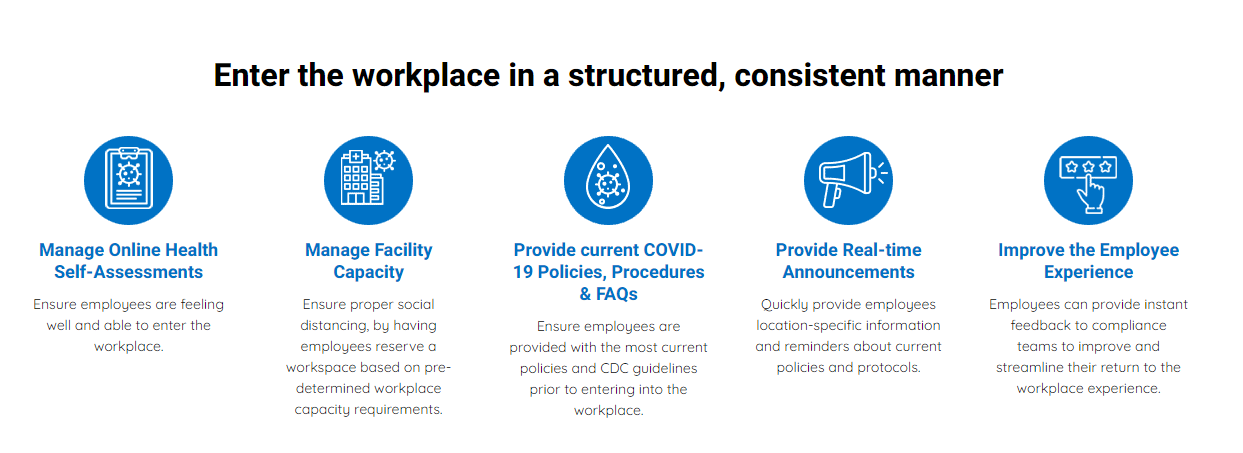
So, why RETURN: Companies can get a head-start with a pre-built framework based on the most current CDC and public health guidance to support a return to the workplace. Some of the value features are listed below for your quick reference:

  • Free and easy to scale on Microsoft PowerApps.
  • Mobile Ready - available over any mobile device, browser and as a mobile app as well.
  • Configurable - Simple to configure workflows to the specific needs of your facilities and business.
  • Accelerator Development - Ability to produce powerful functionality at a fraction of the cost compared to the development of custom code for the same purpose. 
  • Automated Solution - An efficient way to shift away from manual, paper-driven work within HR and other departments.
  • Secure & Efficient - ability to leverage the user’s secure environment from the start, no PII data is hosted by the RETURN framework.
  • Ready to use with minimal config. - facility management, Policies, FAQ's, each screen header text, questions for Health assessment, and Check-in can be easily configured.
  • Robust Real-Life Use cases in MVP since it is going to be used internally by Neudesic.

We are targeting 3 personas here in the RETURN APP

  • Employees who wish to come to the workplace and they will have the ability to reserve workspace for a particular date in that facility
  • Next is the Compliance team is responsible for executing policies, perform check-ins via health screening , send out announcements and manage supplies i.e. masks, Sanitizers etc., per facility.
  • Finally, the Governance Committee or a set of Admins – i.e. HR legal and C-Team responsible for establishing & enforcing the Neudesic Policies as related to COVID-19 

Features Supported:


Watch a quick video!